Complete Expanded Edition

A History of
Israel & Palestine

From Ancient Kingdoms to Modern Conflict

12
Chapters
95+
Pages
100+
Primary Sources
3,000
Years Covered

A comprehensive, rigorously sourced historical curriculum spanning three thousand years — from ancient Israelite kingdoms to the present-day conflict. Written to inform, not to persuade.

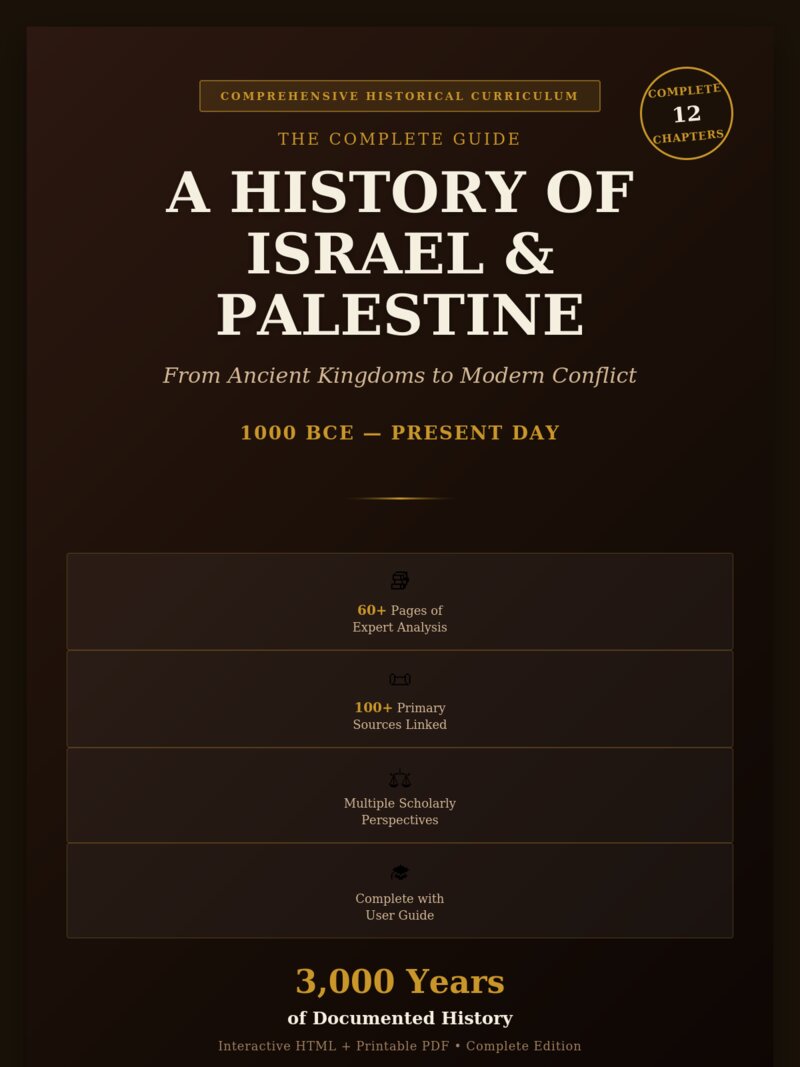
A History of Israel & Palestine — Complete Expanded Edition cover

Understanding Before Taking Sides

The conflict between Israelis and Palestinians is one of the most debated, misunderstood, and emotionally charged topics of our time. News cycles offer fragments. Social media amplifies outrage. This curriculum offers something different: three thousand years of documented context.

Drawing on over 100 primary sources — archaeological records, legal documents, diplomatic correspondence, and firsthand testimony — this work traces the land's story from the ancient Israelite kingdoms through the British Mandate, the founding of modern Israel, the Nakba, and the unresolved present.

Chapters address contested narratives head-on: the Rothschild land purchases, the Haavara Agreement, the etymology of "Holocaust," and the ideology behind the settlement movement. Each presents the scholarly record without partisan framing.

This curriculum presents historical perspectives from both Israeli and Palestinian traditions with equal scholarly care. Informed understanding is the foundation of meaningful dialogue.
"Before we can discuss the future of this land, we must understand the depth of its past — and the legitimacy of every story told about it."
— From the Publisher's Note
Curriculum Highlights
  • Multiple scholarly perspectives on every major dispute
  • 100+ primary sources with direct links
  • Debunks common myths from all political directions
  • Designed for self-study, classrooms & discussion groups
  • Available as eBook & paperback on Amazon

Inside the Curriculum

Twelve chapters across three parts — 1000 BCE to the present day.

Part I  ·  Ancient & Medieval Periods
01
c. 1000 – 586 BCE
King David & Ancient Israel

The emergence of the Israelites, the tension between archaeological evidence and biblical narrative, the Tel Dan Stele, the divided kingdom of Israel and Judah, and the Babylonian conquest of Jerusalem.

02
586 BCE – 135 CE
Exile, Return & Roman Rule

The Babylonian exile and Persian restoration, the Second Temple period, the Hasmonean kingdom, Roman conquest, two Jewish revolts, and Hadrian's renaming of the province to "Syria Palaestina."

03
135 – 636 CE
Byzantine, Persian & Late Roman Palestine

How Christianity transformed Palestine's religious landscape, the Mishnah's compilation, the near-annihilation of the Samaritans, the Persian invasion of 614, and the eventual collapse of Byzantine control.

04
636 – 1900 CE
Islamic Conquest to Ottoman Empire

The Arab-Muslim conquest, dhimmi legal status, Jerusalem as Islam's third holiest site, the Crusades and Saladin's recapture, Mamluk rule, the Ottoman period, and 19th-century demographic realities.

Part II  ·  Modern Zionism & Conflict Origins
05
1880 – 1920
Zionism & the Balfour Era

European antisemitism and the rise of Theodor Herzl's political Zionism, the First and Second Aliyot, WWI's competing promises — McMahon-Hussein, Sykes-Picot, and the Balfour Declaration — and the British Mandate.

06
1880 – 1948
The Rothschilds & Land in Palestine

Baron Edmond de Rothschild's philanthropic role in early Jewish settlement, the mechanics of land purchases, the displacement of Arab tenant farmers, and a careful examination of conspiracy claims versus documented history.

07
1933 – 1945
The Haavara Agreement & WWII

Nazi persecution and the 1933 Transfer Agreement that allowed German Jews to emigrate to Palestine, the fierce internal Jewish debate it provoked, the Holocaust, and an honest accounting of what collaboration claims do and do not show.

08
Etymology & Usage
The Word "Holocaust"

The ancient Greek origins of the term, its usage in 19th- and 20th-century literature before the Nazi period, its postwar formalization as a specific historical descriptor, and a thorough debunking of the "1993 invention" myth.

Part III  ·  State Formation & Ongoing Conflict
09
1947 – 1950
Birth of Israel & the Nakba

The UN Partition Plan, the civil war, Israel's declaration of independence, the 1948 Arab-Israeli War, the Palestinian refugee crisis, and the competing narratives — liberation and catastrophe — that both peoples carry from the same events.

10
Settlements & Territorial Claims
"Greater Israel" — The Ideology

Biblical boundaries and their political use, the rise of Revisionist Zionism, the 1967 conquest, the settlement movement's growth to 700,000 settlers in the West Bank and East Jerusalem, and their standing under international law.

11
1948 – Present
Wars, Oslo & the Modern Era

All major Arab-Israeli wars, the Intifadas, the Oslo Accords and their collapse, the rise of Hamas and the Gaza blockade, the October 7, 2023 attacks and Israel's military response, and the unresolved questions that define today.

12
Appendix · User Guide
About This Curriculum — README

What makes this curriculum unique, how to use it effectively for self-study or classroom settings, a complete guide to the primary sources, the pedagogical approach and its reasoning, and defined learning outcomes for each of the three parts.

Turning Points in 3,000 Years

The moments that reshaped the land, its peoples, and the conflict that continues today.

~1000 BCE

United Kingdom of Israel — David & Solomon

Israelite tribes unite under King David; Jerusalem becomes the capital. Solomon builds the First Temple. The Tel Dan Stele later provides one of the earliest extra-biblical references to the "House of David."

586 BCE

Babylonian Conquest & First Exile

Nebuchadnezzar destroys Jerusalem and the First Temple. The Jewish population is taken into Babylonian captivity — the beginning of the diaspora experience that will define Jewish identity for centuries.

70 CE

Rome Destroys the Second Temple

Titus crushes the Jewish revolt and demolishes the Second Temple. In 135 CE, after the Bar Kokhba revolt, Hadrian renames the province "Syria Palaestina" and bans Jews from Jerusalem.

636 CE

Arab-Muslim Conquest of Jerusalem

Caliph Umar ibn al-Khattab enters Jerusalem. The Dome of the Rock is completed in 691 CE, cementing Jerusalem as Islam's third holiest city. The region enters more than a millennium of Islamic governance.

1917

The Balfour Declaration

Britain promises support for "a national home for the Jewish people" in Palestine — without prejudicing the rights of existing non-Jewish communities. Both promises would prove impossible to honor simultaneously.

1933

The Haavara (Transfer) Agreement

Nazi Germany and the Zionist Federation sign an agreement allowing around 60,000 German Jews to emigrate to Palestine in exchange for the purchase of German goods. The agreement remains contested among historians and in Jewish memory.

1948

Israeli Independence / Al-Nakba

Israel declares independence on May 14. For Israelis: the realization of a centuries-long aspiration. For Palestinians: Al-Nakba — "The Catastrophe" — as approximately 700,000 Arabs flee or are expelled from their homes.

1967

The Six-Day War & Occupation Begins

Israel captures the West Bank, Gaza Strip, Sinai, and Golan Heights. The occupation of Palestinian territories begins. UN Resolution 242 calls for Israeli withdrawal; it remains unfulfilled more than fifty years later.

1993

Oslo Accords

Israel and the PLO sign the Oslo Accords. The two-state solution appears within reach. Rabin is assassinated in 1995; Camp David collapses in 2000; the Second Intifada follows. The framework does not recover.

Oct. 2023

October 7 & the Gaza War

Hamas launches a devastating cross-border attack on southern Israel, killing approximately 1,200 people. Israel responds with a large-scale military campaign in Gaza. The war reignites all of the historical questions this curriculum addresses.

A History of Israel & Palestine — Complete Expanded Edition

The Complete Expanded Edition

All 12 chapters, 95+ pages, and over 100 primary sources with direct links. Available on Amazon as both an eBook and a paperback. Whether you're a student, educator, journalist, or curious reader, this curriculum was built for you.

95+ pages of content
100+ primary sources linked
Multiple scholarly perspectives
User guide & README included
Available as eBook & paperback
Classroom & self-study ready
eBook Paperback Available on Amazon

All proceeds support continued independent research and educational publishing at People for a Better World Understanding. © 2026.

Contact & Discussion

Questions about the history, source corrections, educational licensing, or simply thoughts you'd like to share — we welcome all thoughtful dialogue.

✓ Thank you — your message has been received. We'll be in touch soon.